A Geotechnical Guide to Hardscaping in the 928xx Zip Codes
Introduction: The Ground Beneath Your Feet
When planning a driveway, patio, or pool deck in Anaheim, most homeowners focus on the surface—the color, the texture, the pattern. But the longevity of your investment is determined by what lies six inches below the surface.
Anaheim, and much of Orange County, sits on a geological formation rich in Expansive Clay Soils (often called “Adobe”). This soil is the silent destroyer of concrete. Understanding how this soil behaves is the key to choosing a hardscape that will last for decades rather than years.
1. The Science of Soil Failure
Expansive clay is “hydro-active.”
The Swell: When it rains (or when you irrigate), the clay absorbs water and expands volume significantly. This creates upward pressure (heave) on anything sitting on top of it.
The Shrink: When the soil dries out during our long, hot summers, it shrinks and cracks, creating voids.
The Concrete Failure Mode: Poured concrete is a “monolithic” (single piece) slab. It is rigid. It cannot bend. When the soil heaves up in the middle or shrinks away at the edges, the concrete slab is subjected to tension forces it cannot withstand. The result? Structural Cracking.
2. The Engineering Solution: Flexible Pavement Systems
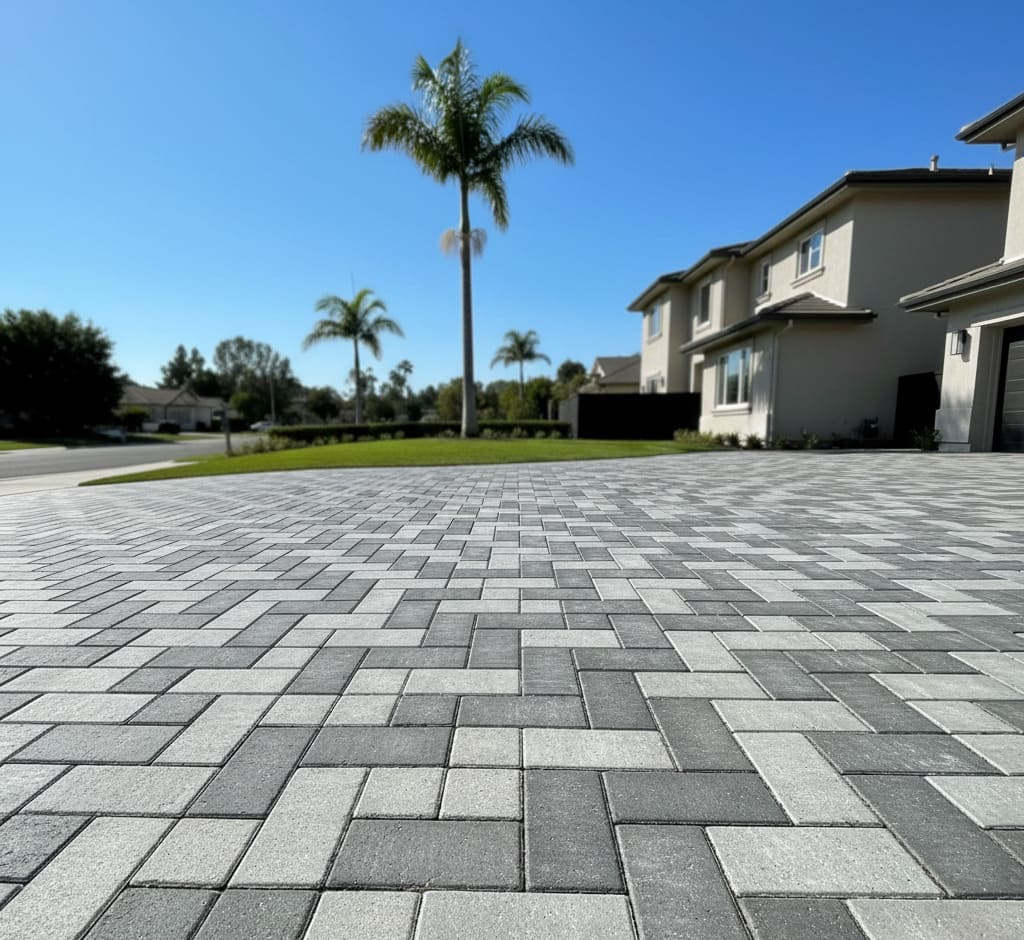
Enter the Interlocking Concrete Paver (ICP). Unlike a rigid concrete slab, a paver patio is a flexible system. It consists of thousands of individual high-strength concrete units interlocked with sand.
Articulated Movement: Because the pavement is segmented, it can flex. When the clay soil below heaves, the paver field undulates slightly to accommodate the movement. It moves with the earth rather than fighting it.
Load Distribution: The interlocking joints transfer loads (like the weight of a car) horizontally across the surface, preventing the pavers from tipping or sinking.
Compressive Strength: Standard concrete is rated at roughly 3,000 PSI (Pounds per Square Inch). High-quality pavers from manufacturers like Belgard are manufactured to exceed 8,000 PSI. They are nearly three times stronger than the foundation of your house.
3. Aesthetic Trends for 2025: The “New” Paver Look
Gone are the days of the small, red, tumbled brick pavers. The 2025 aesthetic in Anaheim is defined by Scale and Line. Consult with expert hardscape contractors near me to visualize these patterns.
3.1 The Linear Modernist (Belgard Melville Plank)
The Look: Long, narrow pavers with smooth faces and tight joints.
The Application: Often laid in a herringbone pattern. This mirrors the look of interior hardwood flooring or large-format tile, blurring the line between indoors and outdoors. It visually elongates small backyards and complements modern architectural styles.
3.2 The Modern Stone (Belgard Catalina Grana)
The Look: A three-piece modular system with a crisp, smooth finish.
The Application: Perfect for pool decks and patios where a clean, “slate-like” appearance is desired without the irregularity of natural stone. The modular pattern breaks up large spaces, making it ideal for expansive driveways.
3.3 The Textured Traditionalist (Belgard Lafitt Rustic Slab)
The Look: Modeled after natural cut flagstone, with a textured, undulating surface.
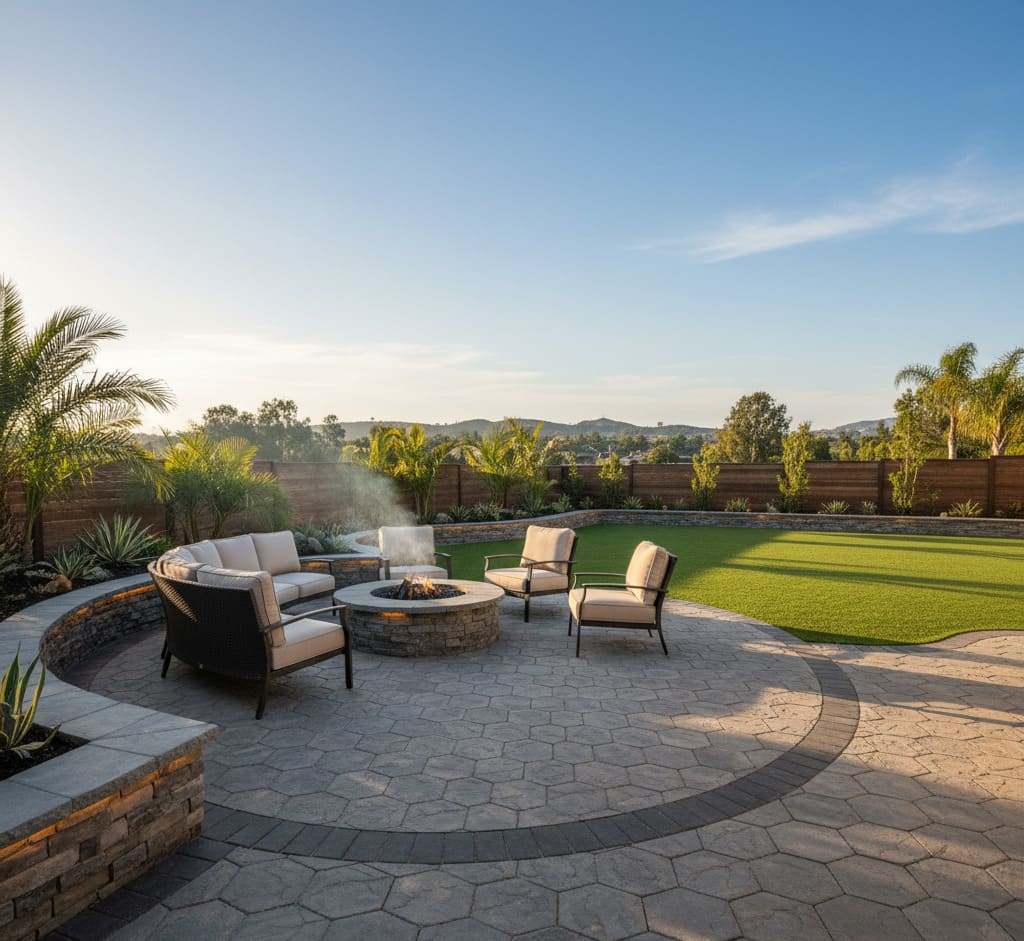
The Application: Excellent for transitional homes (e.g., Anaheim Hills estates). The texture provides superior slip resistance, making it a safe choice for households with children or elderly residents.
4. Water Management: The Permeable Advantage
Anaheim’s landscape guidelines increasingly emphasize “permeability”—the ability of the ground to absorb rainwater to prevent urban flooding and pollution.
Permeable Interlocking Concrete Pavers (PICP): These systems utilize wider joints filled with crushed stone chips (not sand). Permeable systems pair perfectly with artificial grass for a zero-runoff yard.
The Function: Rainwater passes instantly through the joints and into a gravel reservoir base below. The water then slowly infiltrates the native soil.
The Benefit: No puddles. No runoff. Compliance with city water capture goals. And, importantly, keeping the clay soil at a more consistent moisture level, which reduces the violence of the shrink-swell cycle.
5. The Invisible Engineering: How GAGA US Construction Builds
Anyone can lay pavers on dirt. That is a recipe for failure. A professional installation is 80% preparation and 20% paver placement.
Step 1: Deep Excavation
We remove 6 to 8 inches of the native clay soil. We do not build on the problem; we remove the problem.
Step 2: Geotextile Stabilization
This is the secret weapon. We install a heavy-duty Geotextile Fabric over the soil. This fabric has high tensile strength. It prevents the clay from mixing with the gravel base (contamination) and bridges any small voids that form, stabilizing the entire structure.
Step 3: The Structural Base
We install a thick layer of Class II Road Base—a mixture of crushed rock and stone dust. This is compacted to 98% density using heavy vibratory plate compactors. This creates a rock-hard, non-expansive foundation for the pavers.
Step 4: The Bedding Sand
A 1-inch layer of sharp, angular sand is screeded over the base. This is the “pillow” the pavers sit on.
Step 5: Polymeric Joint Sand
We don’t use regular sand for the joints. We use Polymeric Sand, which contains special polymers that activate with water. The sand hardens to the consistency of grout, locking the pavers together, preventing weeds, and stopping ants, while still remaining flexible enough to absorb seismic movement.
6. The Financial Case: Concrete vs. Pavers
Stamped Concrete: Cheaper upfront ($12-$18/sq. ft.). But it will crack, and the sealer will fade, requiring resealing every 2 years. A cracked driveway lowers home value.
Pavers: Higher initial investment ($20-$35/sq. ft.). But they come with a lifetime material warranty. They do not crack. If a tree root lifts them, they can be repaired invisibly.
The Verdict: Over a 10-year period, the Total Cost of Ownership for pavers is often lower than concrete due to zero repair costs and higher retained asset value. If you are budgeting for a full exterior remodel, consider fence installation costs as well.
Conclusion
Hardscaping is the foundation of your outdoor living space. In the challenging geology of Anaheim, rigid concrete is a gamble. Flexible paver systems are an engineered solution. By choosing the right material and the right subsurface preparation, you are building an asset that will withstand the earth’s movement and the test of time.